

Yes, using a self-tanner while breastfeeding is generally considered low risk when you follow a few simple precautions. The key active ingredient in most sunless tanners, dihydroxyacetone (DHA), works on the outermost layer of dead skin cells and is expected to enter the bloodstream in only very small amounts. The single most important safety step is straightforward: never apply product to your breasts or nipples, and always wash the area before feeding while breastfeeding.
Here are the top precautions at a glance:
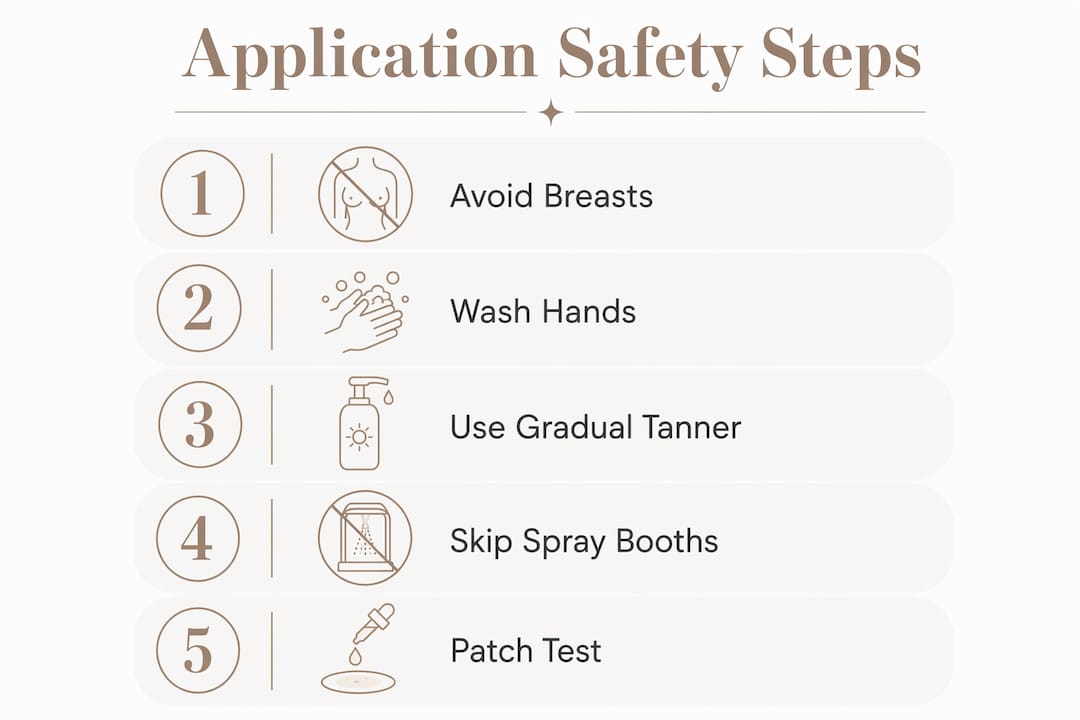
- Avoid the breast and nipple area entirely during application.
- Wash your chest and breast area before every feed after tanning while breastfeeding.
- Choose at-home formats (lotions, mousses, tanning waters) over salon spray booths to remove any inhalation risk.
- Wait until the product has fully dried and ideally shower before skin-to-skin contact with your baby.
- Do a patch test 24–48 hours before a full application, especially if your skin is more sensitive postpartum.
Table of Contents
- How DHA works on your skin and why it rarely reaches breast milk
- What the evidence and expert resources say about nursing and sunless tanners
- Salon spray booths vs at-home tanning: which is safer for nursing mothers?
- How to apply self-tanner safely while breastfeeding: a step-by-step guide
- Ingredients and skincare interactions to watch for while nursing
- When not to use self-tanner and when to contact a clinician
- Key takeaways
- A note on evidence and what it actually tells us
- After5 gradual tanning water: a natural fit for nursing mothers
- Useful sources and further reading
How DHA works on your skin and why it rarely reaches breast milk
DHA is a simple sugar that reacts with amino acids in the dead cells of your skin’s outermost layer, the stratum corneum, to produce a temporary brown colour. Because this reaction happens in cells that have no blood supply, the ingredient does not need to penetrate deeply to do its job. Only very small amounts of topically applied DHA are expected to enter the bloodstream, and absorption is lower still on healthy, intact skin with infrequent use.
The FDA approved DHA for external cosmetic use in the 1970s. Crucially, that approval covers topical application only. It does not extend to inhalation or use near the eyes, lips, or mucous membranes, because sufficient safety data for those routes simply does not exist. This is the regulatory reason spray booths require more caution than a lotion you apply at home.
What this means in practice: the safety actions that matter most are behavioural, not pharmacological. Keeping the product away from your nipples and washing before feeds addresses the realistic exposure routes, because DHA itself acts in the dead skin layer rather than circulating freely through your body.
What the evidence and expert resources say about nursing and sunless tanners
The honest answer is that breastfeeding-specific clinical trials for sunless tanners do not exist. That is a knowledge gap, not a safety prohibition, and it is worth understanding what the major resources actually say.
MotherToBaby / NCBI fact sheet notes that no studies specifically examine sunless tanners while breastfeeding, but concludes that only very small amounts of DHA are expected to reach the bloodstream and pass into breast milk. The absence of data reflects the reality that cosmetic ingredients are not required to undergo breastfeeding-specific trials before approval.
La Leche League International takes a reassuring position. Their guidance states that the active ingredients in most fake tans, DHA and erythrulose, are non-toxic and do not penetrate beyond the outermost skin layer. Their practical advice focuses on avoiding direct infant skin contact until the product has dried or been rinsed off.
InfantRisk and clinical summaries echo the same theme: the theoretical risk from topical DHA is low, but the absence of breastfeeding-specific data means clinicians may not have trial evidence to draw on if you ask them directly.
The practical takeaway from all three sources is consistent: the risk profile is low, the precautions are simple, and if you have specific concerns about a product’s full ingredient list, your GP or midwife is the right person to ask.
Salon spray booths vs at-home tanning: which is safer for nursing mothers?
The format you choose matters more than the brand. Here is how the two main options compare:
| Factor | Salon spray booth | At-home lotion, mousse or tanning water |
|---|---|---|
| Inhalation risk | Present — atomised DHA mist can be breathed in | None — no airborne particles |
| Control over application | Limited — technician or booth controls coverage | Full — you decide exactly where product goes |
| Breast/nipple avoidance | Harder to guarantee | Easy to manage yourself |
| Timing around feeds | Requires travel and scheduling | Fits around your feeding routine at home |
| Typical DHA concentration | Varies; often higher in professional formulas | Usually lower and gradual in consumer products |
At-home self-tanning products are considered the most straightforward option for breastfeeding mothers precisely because they remove the inhalation question entirely. You apply only what you need, only where you choose, and you can time it perfectly around a feed.

Spray tanning in booths raises a separate concern: atomised DHA mist can be inhaled during application. This is the main theoretical risk that clinical and industry sources flag, and it is the reason the FDA’s approval of DHA does not cover inhalation.
Pro Tip: If you do choose a salon spray tan, ask about booth ventilation, wear a nose-and-mouth mask during application, and use pasties or a barrier cream to protect the nipple area. These steps significantly reduce inhalation and contact exposure.
A gradual tanning water applied at home is the simplest way to keep full control over where the product goes and when you shower it off before your next feed.
How to apply self-tanner safely while breastfeeding: a step-by-step guide
A clear routine makes the whole process easy and worry-free. Follow these steps for a safe, natural-looking result.
Before you apply:
- Choose a time right after a feed so you have the longest possible gap before the next one.
- Exfoliate gently and moisturise dry areas (elbows, knees, ankles), but skip strong actives like retinoids or glycolic acid for 24–48 hours beforehand.
- Lay out disposable gloves, a barrier cream or petroleum jelly, and your tanning product.
During application:
- Apply a thin layer of petroleum jelly around and over your nipples and areolae before you start. This creates a simple physical barrier.
- Put on disposable gloves to protect your palms and prevent uneven colour on your hands.
- Apply the product to your body, working away from the breast area entirely. Keep a clear margin around the chest.
- Blend carefully at the edges of any avoided areas so the result still looks natural.
After application:
- Allow the product to dry fully before dressing. Wear loose, dark clothing during the development period.
- Avoid skin-to-skin contact with your baby until after your first shower.
- Shower and wash your breast area thoroughly before the next feed, paying particular attention to any bronzer (the wash-off guide colour many products include).
Pro Tip: Cover your nipples with a thin layer of petroleum jelly before applying, and use disposable gloves throughout. The cosmetic bronzer in many products is the part most likely to transfer — a thorough wash of the breast area before feeding removes it completely.
Keep these points in mind throughout:
- Never apply product directly to the breast, nipple, or areola.
- Do not feed until you have showered and washed the breast area.
- If you use a pump, stored milk gives you flexibility to shower before the next feed without any time pressure.
- Avoid letting your baby touch treated skin until after your first shower.
Ingredients and skincare interactions to watch for while nursing
Most self-tanners are straightforward, but a few ingredient combinations are worth knowing about, especially if you already use active skincare products.
Retinoids (retinol, tretinoin, adapalene): These speed up cell turnover, which means the fresh cells DHA needs to react with are shed faster. The result is a patchy, short-lived tan. Pause retinoids 24–48 hours before and after tanning. This also matters because many breastfeeding mothers are advised to avoid high-strength retinoids anyway; check with your GP if you are unsure about your current routine.
AHAs and BHAs (glycolic acid, lactic acid, salicylic acid): These exfoliating acids remove the dead skin cells that DHA reacts with, causing uneven fading. Avoid them for 24–48 hours either side of a tanning session.
Benzoyl peroxide: Can oxidise DHA and cause unexpected discolouration. Keep it away from areas you plan to tan.
For your face specifically:
- Choose a lower-concentration or gradual formulation rather than a full-strength self-tanner.
- Avoid layering DHA directly over a fresh retinoid application.
- Perform a 48-hour patch test in a discreet area (inside the wrist or behind the ear) before applying to your face.
Pro Tip: If you want a natural-looking result that lasts, pause your active skincare routine for two days around your tanning session. Your tan will develop more evenly and fade more gradually.
Allergy and sensitivity considerations are also worth a moment’s thought. Postpartum skin can behave differently to how it did before pregnancy. A patch test 24–48 hours before a full application is a simple way to catch any unexpected reaction before it covers a large area.
When not to use self-tanner and when to contact a clinician
There are a small number of situations where it is better to wait or seek advice before tanning.
Stop using self-tanner and contact your GP or midwife if you notice:
- Cracked or bleeding nipples — product should never contact broken skin.
- An allergic reaction: redness, itching, swelling, or hives after application.
- A skin rash on your baby’s face or body after a feed, particularly if it appears after a tanning session.
- Persistent nipple pain that begins or worsens after you start using a new product.
Avoid self-tanning altogether if you have:
- Open wounds, sores, or active dermatitis on or near the breast area.
- Recent nipple trauma or a current nipple infection (thrush, mastitis).
- A known allergy to DHA, erythrulose, or any fragrance or preservative commonly found in tanning products.
When you do contact your midwife or GP, bring the product name and its full ingredient list. This makes it much easier for them to give you specific, relevant advice rather than a general caution. The NHS advises checking with your midwife or GP before using cosmetic products on sensitive skin areas while breastfeeding; the NHS guidance on fake tan is a useful starting point, though it focuses primarily on pregnancy rather than breastfeeding specifically.
This article is general information, not medical advice. For guidance specific to your situation, speak with your GP or midwife.
Key takeaways
Topical self-tanners are considered low risk while breastfeeding when you avoid the breast and nipple area, wash before feeding, and choose at-home formats over salon spray booths.
| Point | Details |
|---|---|
| DHA stays in dead skin cells | Topical DHA is expected to enter the bloodstream in only very small amounts, making breast milk transfer unlikely. |
| No breastfeeding-specific trials exist | The absence of studies is a knowledge gap, not a safety ban; major resources rate the theoretical risk as low. |
| At-home formats remove inhalation risk | Lotions, mousses, and tanning waters give you full control and eliminate the airborne DHA concern of spray booths. |
| Wash before every feed | Always shower and wash the breast area after tanning before feeding your baby, particularly to remove any cosmetic bronzer. |
| Helloafter5 After5 Original Gradual Tanning Water | Gradual self tanner tanning water — an oil-free, hydrating at-home format that gives you full control over application and fits easily around a feeding schedule. |
A note on evidence and what it actually tells us
There is a tendency in beauty and wellness writing to treat “no studies” as either a green light or a red flag, depending on which conclusion the writer wants to reach. Neither reading is quite right.
The honest position is this: cosmetic ingredients are not required to undergo breastfeeding-specific clinical trials before they reach the market. That is true of thousands of products you already use without a second thought. For DHA specifically, the mechanism is well understood. It reacts in dead skin cells, systemic absorption is expected to be minimal, and the major clinical resources that have reviewed the available evidence all arrive at the same cautious-but-reassuring conclusion while breastfeeding.
What I find more useful than debating the absence of trials is focusing on what the evidence does tell us: the practical risk comes from behavioural choices, not from the chemistry of DHA itself. Applying product to your nipples, skipping a wash before feeding, or inhaling mist in a spray booth are the scenarios that create genuine exposure. Remove those behaviours and you remove the realistic risk.
The other thing worth saying plainly: if you are already exhausted, feeding around the clock, and just want to feel a little more like yourself, a gradual tanning water applied carefully at home is a very reasonable choice. You do not need to feel guilty about it. You just need to do it sensibly.
After5 gradual tanning water: a natural fit for nursing mothers
If you have decided that an at-home format is the right choice, Helloafter5’s After5 range is worth a look. The products are designed with exactly the kind of lightweight, non-greasy formula that works well when you need to apply carefully, dry quickly, and wash off cleanly before a feed.
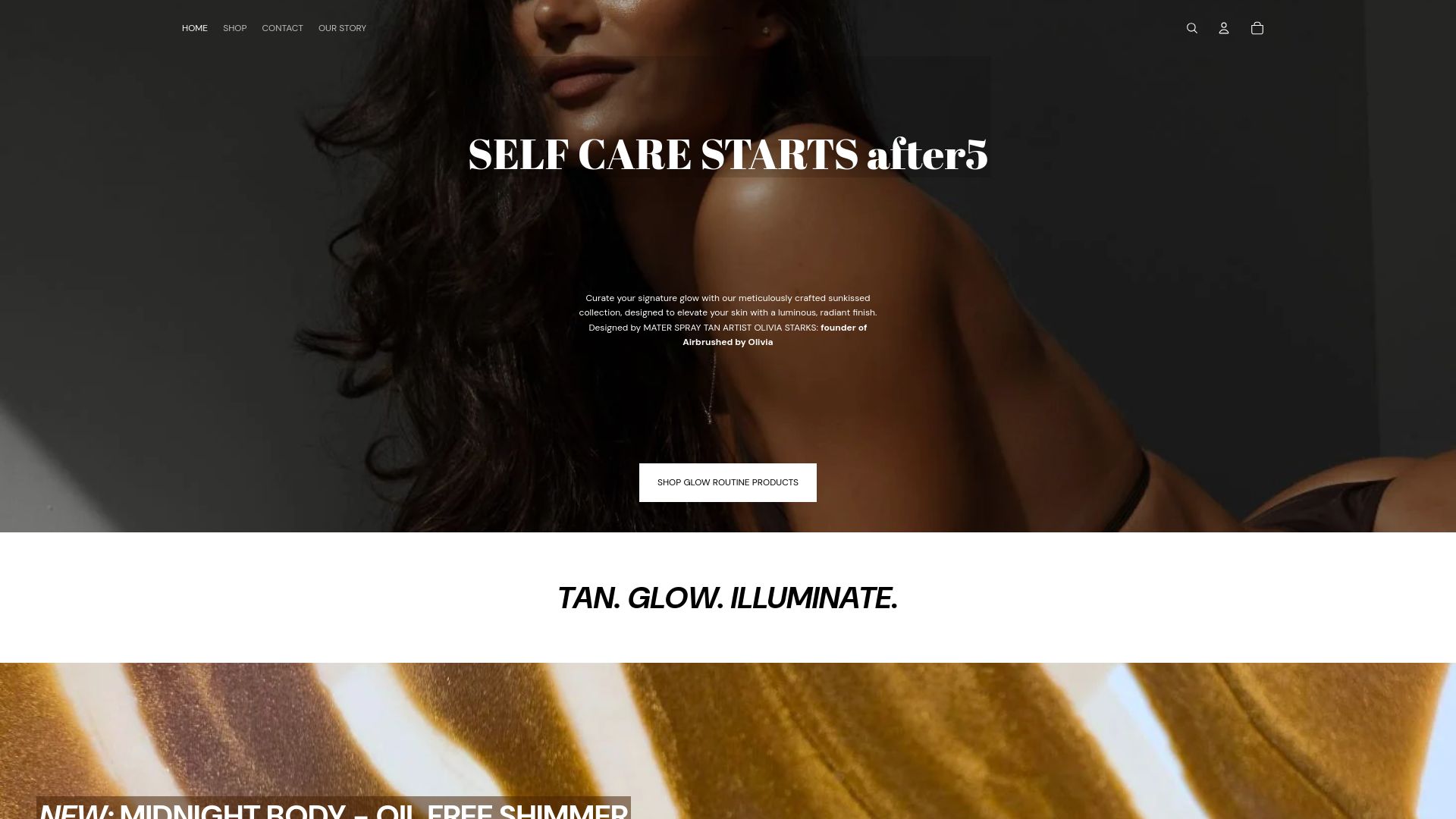
The After5 Original Gradual Tanning Water builds colour gradually, so you stay in control of the depth of your tan without committing to a full application in one go. It is oil-free and formulated with hyaluronic acid and aloe vera, which means it hydrates as it tans rather than leaving skin feeling tight or dry. The Midnight Body oil-free shimmer is a wash-off option for days when you want an immediate glow without any DHA development time at all, making it easy to rinse off completely before your next feed. There is also a travel-size 15ml tanning water that fits in a changing bag without taking up space.
If you are uncertain about any specific ingredient in relation to your own health or your baby’s, take the product page ingredient list to your GP or midwife before your first use. Browse the full After5 range at helloafter5.com and find the format that fits your routine.
Useful sources and further reading
The guidance in this article draws on the following authoritative resources. For personalised advice, speak with your GP or NHS midwife and bring the product name and full ingredient list with you.
- MotherToBaby / NCBI fact sheet on sunless tanners — primary source on DHA absorption and breastfeeding evidence gaps.
- MotherToBaby fact sheet (mothertobaby.org) — accessible summary of the same evidence for general readers.
- La Leche League International: tanning beds and fake tans — position statement on DHA, erythrulose, and infant contact.
- Talking Tan: spray tan while breastfeeding — practical clinical and industry guidance on inhalation risk and at-home formats.
- NHS: is it safe to use fake tan during pregnancy? — UK NHS guidance (pregnancy-focused, but relevant context for breastfeeding mothers).
- After5 product pages at helloafter5.com — ingredient lists and product format details for the After5 gradual tanning water and oil-free shimmer.
Recommended
- How to Get a Natural-Looking Tan That Actually Matches Your Skin Tone – after5: Sunless Tanning Water + Self-Care Products
- Gradual Tanning Water: Why It’s the Ultimate Glow Hack for Your Skin – after5: Sunless Tanning Water + Self-Care Products
- Tanning Water| Oil Free Body Shimmer| Gradual Tanning| after5 – after5: Sunless Tanning Water + Self-Care Products
- Oil-Free Body Shimmer: Why It’s the Secret to a Radiant Body Glow and – after5: Sunless Tanning Water + Self-Care Products